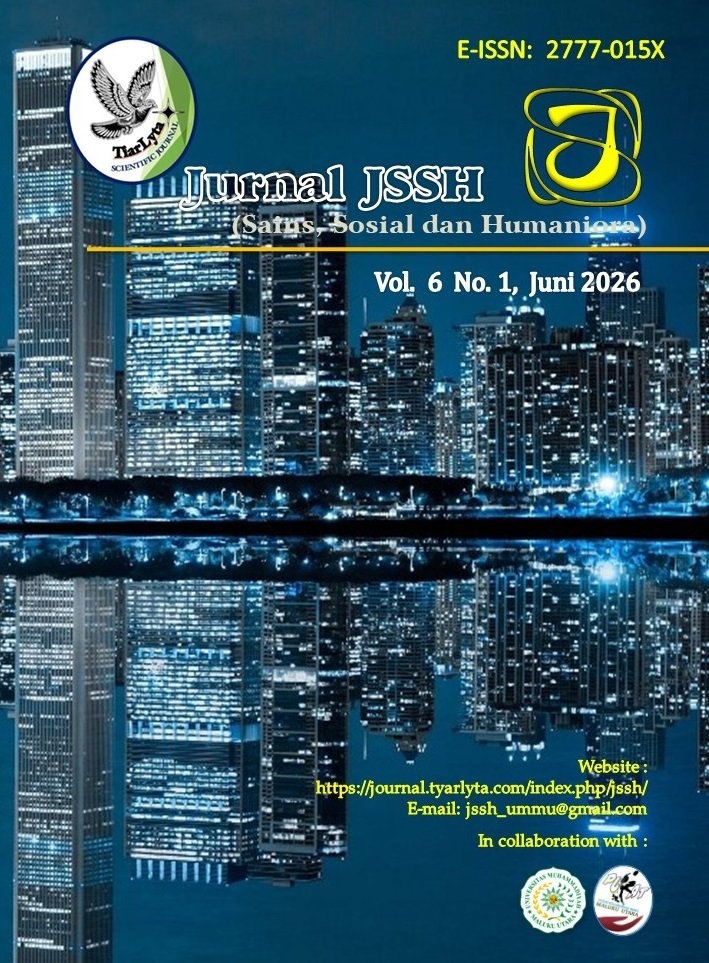
Ternate Spice Route Heritage
Optimizing Historical Legacy for Education
DOI:
https://doi.org/10.52046/jssh.v6i1.2750Keywords:
Spice Route, Heritage, History Education, Ternate, Cultural IdentityAbstract
The Spice Route is one of the most important historical heritages that made Ternate a global trading center since the 15th century. The presence of spices, especially cloves and nutmeg, attracted the attention of European nations and brought significant changes in political, social, and cultural aspects in North Maluku. This article discusses the use of the Spice Route heritage site in Ternate City as a medium for history education. Research results show that experiential learning at heritage sites can increase students' interest in learning while strengthening their understanding of Ternate's role in global trade. The article also offers strategic recommendations, including the development of a Spice Route curriculum, the use of digital technology, multi-party collaboration, strengthening local identity, and improving teacher competence. With a contextual and interactive approach, the historical heritage of the Spice Route can become a source of inspiration as well as a means to build character.
References
Baharuddin. (2015). [Judul tidak tersedia]. [Sumber tidak tersedia]. Catatan: data penulis, tahun, judul, dan sumber tidak lengkap.
Darling‑Hammond, L., Hyler, M. E., & Gardner, M. (2017). Effective teacher professional development. Palo Alto, CA: Learning Policy Institute.
Fisher, W. R. (1984). Narration as a human communication paradigm: The case of public moral argument. Communication Monographs, 51(1), 1‑22.
Galtung, J. (1997). Peace education: What is it? How does it work ?. International Review of Education, 43(1‑2), 5‑19.
Gardner, H. (1983). Frames of mind: The theory of multiple intelligences. New York, NY: Basic Books.
Hidayat. (2017). [Judul tidak tersedia]. [Sumber tidak tersedia]. Catatan: data penulis, tahun, judul, dan sumber tidak lengkap.
Kementerian Pendidikan dan Kebudayaan RI. (2020). Revitalisasi Jalur Rempah. Jakarta: Kemendikbud.
Koentjaraningrat. (2009). Pengantar Ilmu Antropologi. Jakarta: Rineka Cipta.
Kolb, D. A. (1984). Experiential Learning: Experience as the Source of Learning and Development. Englewood Cliffs, NJ: Prentice Hall. Moleong, L. J. (2017). Metodologi Penelitian Kualitatif. Bandung: PT Remaja Rosdakarya. Koentjaraningrat. (2009). Pengantar Ilmu Antropologi. Jakarta: Rineka Cipta.
Lestari, [Inisial tidak tersedia]. (2020). [Judul tidak tersedia]. [Sumber tidak tersedia]. Catatan: nama lengkap penulis, judul, dan sumber tidak lengkap.
Lickona, T. (1991). Educating for character: How our schools can teach respect and responsibility. New York, NY: Bantam.
Ministry of Education and Culture of the Republic of Indonesia. (2010). Kebijakan pendidikan karakter nasional. Jakarta: Kemdikbud.
Moleong, L. J. (2017). Metodologi Penelitian Kualitatif. Bandung: PT Remaja Rosdakarya.
Schank, R. C., & Abelson, R. P. (1995). Knowledge and memory: The real story. In R. C. Schank (Ed.), The Oxford handbook of cognitive psychology (pp. 435‑452). New York, NY: Oxford University Press.
Seymour, J. P. (2001). Technology in the service of education. New York, NY: Routledge.
Smith, L. (2006). Uses of heritage. Routledge.
Suryanti. (2016). [Judul tidak tersedia]. [Sumber tidak tersedia]. Catatan: data penulis, tahun, judul, dan sumber tidak lengkap.
Tarrayo, H. (2012). Globalisasi dan identitas budaya lokal. Jakarta: Pustaka Pelajar.
Trilling, B., & Fadel, C. (2009). 21st century skills: Learning for life in our times. San Francisco, CA: Jossey‑Bass.
UNESCO. (2011). Empowering local communities in heritage management. Paris: UNESCO Publishing.
UNESCO. (2013). Education for sustainable development: A global agenda. Paris: UNESCO Publishing.
UNESCO. (2021). Spice Route Nomination as World Heritage. Paris: UNESCO Publishing.
Vygotsky, L. S. (1978). Mind in society: The development of higher psychological processes. Cambridge, MA: Harvard University Press.
Wang. (2019). [Judul tidak tersedia]. [Sumber tidak tersedia]. Catatan: nama lengkap penulis, judul, dan sumber tidak lengkap.
Downloads
Published
How to Cite
Issue
Section
Citation Check
License
Copyright (c) 2026 Fathnun Tan, Muhammad Assagaf , Ahmad Talib, Aisyah Bafagih, Syahnul Sardi Titaheluw , Umar Tangke, Ali Lating , Ibnu W. Laitupa

This work is licensed under a Creative Commons Attribution 4.0 International License.